

If you’re searching for clear, practical guidance on child language development stages, you’re likely wondering what’s normal, what’s not, and how you can best support your child at each step. From first coos and babbles to full sentences and storytelling, language growth can feel both exciting and overwhelming—especially when every child seems to develop at a different pace.
This article breaks down the key milestones in child language development stages, what skills typically emerge at each age, and simple, research-backed ways to encourage stronger communication at home. We draw on established developmental guidelines and insights from pediatric speech and child development experts to ensure the information is accurate, practical, and easy to apply in real life.
Whether you’re looking for reassurance, early warning signs, or everyday activities to boost language skills, you’ll find clear answers and actionable tips right here.
From first cries to first words, every parent waits for that magical moment. It’s natural to wonder: is my child on track? Clinical charts can feel cold and confusing, but real life sounds different. This guide walks you through key child language development stages from birth to five, showing what they actually look and sound like.
You’ll gain clarity, confidence, and simple, practical ways to help:
- Encourage babbling with eye contact
- Expand single words into short phrases
- Turn daily routines into language-rich moments
With reassurance and actionable tips, you’ll know what’s typical, when to relax, and when to seek support.
The Pre-Linguistic Stage (0-12 Months): Building the Foundation
The Pre-Linguistic Stage (0-12 Months) is all about non-verbal communication and receptive language (understanding). In other words, before babies can talk, they’re already learning the rules of conversation. And honestly, I think this stage is wildly underestimated. Parents often wait for “first words,” but the real magic starts much earlier.
First, 0–3 months: babies begin differentiating cries (yes, there’s a hunger cry and a “change me now” cry), along with sweet cooing and gurgling sounds. Then, 4–6 months brings babbling—”bababa,” “dadada”—plus experimenting with pitch and volume. Around this time, many respond to their name. By 7–12 months, they combine sounds, point, wave, and understand simple commands like “no” or “come here.” That’s receptive language in action.
Some argue babies this young “don’t get it.” I disagree. Research shows infants start processing language patterns early (Kuhl, 2004). Those daily interactions literally shape neural pathways.
Parenting hack: use parentese—that high-pitched, sing-song voice—and respond to babbles like real conversations. It may feel silly (okay, very silly), but it works.
Pro tip: narrate your day. Ordinary moments build extraordinary foundations in the child language development stages.
The Holophrastic Stage (12-18 Months): One Word, a Whole World
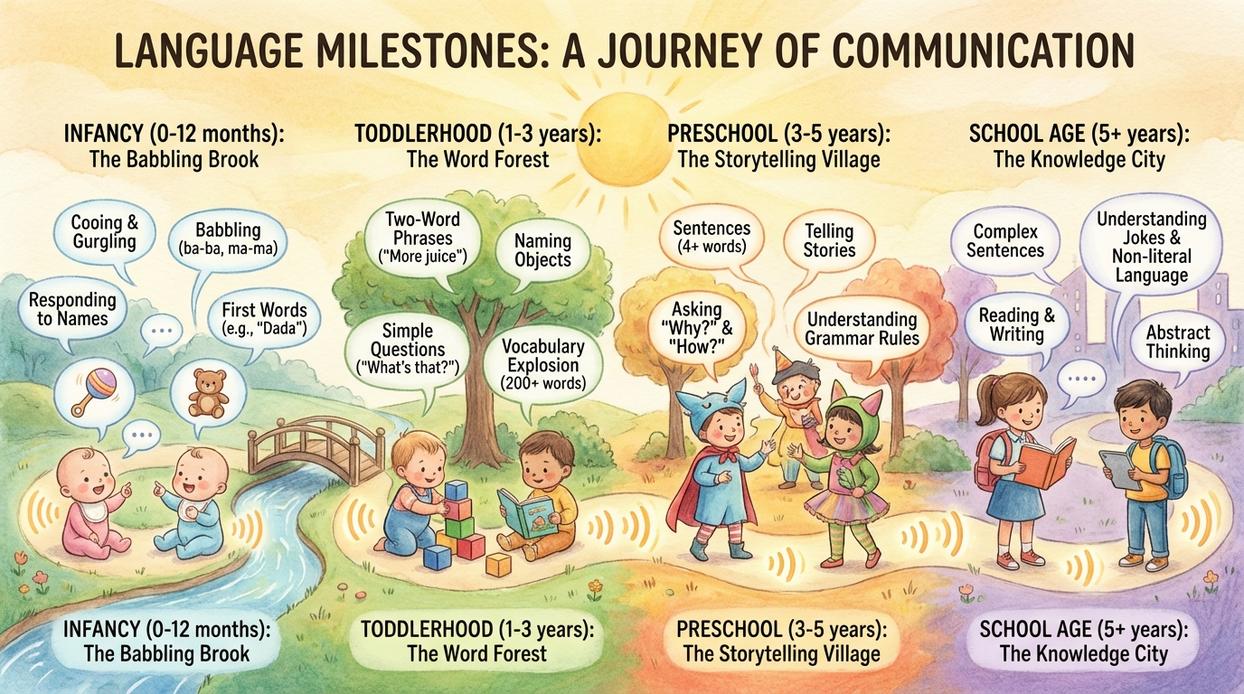
In the holophrastic stage, a child uses one single word to express a complete thought. Holophrastic simply means “whole phrase.” When your toddler says “juice,” they might mean “I want juice,” “There is the juice,” or even “Why is my cup empty?” (Context is everything.) This is one of the most exciting child language development stages because meaning expands faster than vocabulary.
What’s Actually Happening
Between 12 and 18 months, many toddlers experience a vocabulary explosion. They may jump from 1–3 words to 50 words within a few months. Research shows that early word learning accelerates as children begin linking sounds to consistent experiences (Harvard Center on the Developing Child).
Common first words are often nouns like “mama,” “dada,” and “dog,” plus social words such as “hi” and “bye-bye.” These are high-frequency, emotionally loaded words—easy to repeat and rewarding to use.
Real-World Tip: Be a narrator for their world. During meals, say, “Here is your spoon. Scoop the applesauce.” At bath time: “Splash the water!” Repetition builds neural pathways (think of it as installing language software).
Pro tip: Limit background noise and be mindful of how screen time affects growing minds to support clearer word learning.
The Telegraphic Stage (18-24 Months): Two-Word Sentences Emerge)
During toddlerhood, many children enter what linguists call telegraphic speech—the stage where they combine two words to form a basic sentence while leaving out smaller connecting words. Think “mommy go,” “more milk,” or “big doggie.” It’s called telegraphic because it resembles old telegrams that charged by the word (so people skipped the fluff).
In other words, this is the beginning of syntax—the rules that govern how words fit together to create meaning. Grammar is emerging, even if it’s missing articles and prepositions. And while it may sound simple, there’s a lot happening behind the scenes.
At the same time, vocabulary tends to grow rapidly. Expressive vocabulary (the words your child says) expands, and receptive vocabulary (the words they understand) often grows even faster. Sometimes it’s hard to know exactly how much they comprehend—they may surprise you with what they follow or point to.
Parenting Hack: Try “expansion.” If your child says, “car go,” respond with, “Yes, the blue car is going fast!” This models stronger sentence structure without direct correction.
Of course, not every child follows the same timeline. Some linger here; others move quickly. And honestly, researchers still debate how much is biology versus environment. What’s clear? Those two-word phrases are a big leap forward.
Becoming a Conversationalist (2–5 Years)
I still remember when my toddler looked up at me and asked, “Why is the moon following our car?” That was the moment I realized conversation had officially begun (and that bedtime would now take 20 extra minutes).
Child language development stages show a clear progression:
Ages 2-3: Forming 3-4 word sentences, using pronouns (I, you, me), and the start of the endless ‘why?’ questions., – Ages 3-4: More complex sentences, can tell a simple story, and follows multi-step instructions., – Ages 4-5: Speaks clearly, uses adult-like grammar, understands humor and figures of speech, and can explain events in detail.
Around age two, expect short sentences like “Me want juice.” By three, many kids can retell a trip to the park—though the dog might become a dragon halfway through (creative license counts). By four or five, they may negotiate like tiny lawyers.
| Age | What You’ll Notice | How to Support |
|---|---|---|
| 2–3 | Short phrases, “why?” loop |
Expand their sentences |
| 3–4 | Simple storytelling | Ask follow-up questions |
| 4–5 | Detailed explanations | Encourage imagination |
Real-World Tip: Read daily and ask open-ended questions like, “What do you think will happen next?” It builds vocabulary and critical thinking naturally.
While child language development stages offer a helpful roadmap, remember that every child moves at their own pace. Some sprint, some stroll—and both are okay (toddlers aren’t robots). What matters most is progress, not perfection.
Focus on what you can control:
• Create a language-rich home by talking through daily routines, reading together, and asking open-ended questions.
• Listen patiently and celebrate small wins, from first sounds to simple sentences.
Trust your instincts. If concerns linger or progress stalls, consult a pediatrician or speech-language pathologist for reassurance and practical next steps. Early support can make a meaningful difference long term.
Helping Your Child Thrive Through Every Stage
You came here wanting clarity and confidence about supporting your little one’s child language development stages—and now you have a clearer roadmap of what to expect and how to help. From first sounds to full sentences, you understand how each stage builds on the next and why your daily interactions matter so much.
Watching your child struggle to express themselves can feel frustrating and even worrisome. You don’t want to miss a milestone or wonder if you’re doing enough. The good news? With simple, consistent habits—talking, reading, singing, and responsive listening—you can actively support their growth and boost their confidence every single day.
Now it’s time to take action. Start by choosing one small language-building routine you can add today—whether it’s 10 minutes of intentional reading or narrating your daily tasks out loud. If you want step-by-step parenting hacks, practical routines, and real-world strategies trusted by thousands of moms, explore more of our proven resources and start implementing them now. Your child’s voice is growing—make sure you’re nurturing it every step of the way.

 Gladys Mayersavers writes the kind of family buzz content that people actually send to each other. Not because it's flashy or controversial, but because it's the sort of thing where you read it and immediately think of three people who need to see it. Gladys has a talent for identifying the questions that a lot of people have but haven't quite figured out how to articulate yet — and then answering them properly.
They covers a lot of ground: Family Buzz, Curious Insights, Child Development Insights, and plenty of adjacent territory that doesn't always get treated with the same seriousness. The consistency across all of it is a certain kind of respect for the reader. Gladys doesn't assume people are stupid, and they doesn't assume they know everything either. They writes for someone who is genuinely trying to figure something out — because that's usually who's actually reading. That assumption shapes everything from how they structures an explanation to how much background they includes before getting to the point.
Beyond the practical stuff, there's something in Gladys's writing that reflects a real investment in the subject — not performed enthusiasm, but the kind of sustained interest that produces insight over time. They has been paying attention to family buzz long enough that they notices things a more casual observer would miss. That depth shows up in the work in ways that are hard to fake.
Gladys Mayersavers writes the kind of family buzz content that people actually send to each other. Not because it's flashy or controversial, but because it's the sort of thing where you read it and immediately think of three people who need to see it. Gladys has a talent for identifying the questions that a lot of people have but haven't quite figured out how to articulate yet — and then answering them properly.
They covers a lot of ground: Family Buzz, Curious Insights, Child Development Insights, and plenty of adjacent territory that doesn't always get treated with the same seriousness. The consistency across all of it is a certain kind of respect for the reader. Gladys doesn't assume people are stupid, and they doesn't assume they know everything either. They writes for someone who is genuinely trying to figure something out — because that's usually who's actually reading. That assumption shapes everything from how they structures an explanation to how much background they includes before getting to the point.
Beyond the practical stuff, there's something in Gladys's writing that reflects a real investment in the subject — not performed enthusiasm, but the kind of sustained interest that produces insight over time. They has been paying attention to family buzz long enough that they notices things a more casual observer would miss. That depth shows up in the work in ways that are hard to fake.