

Balancing motherhood with personal health can feel overwhelming, especially when your schedule revolves around everyone else’s needs. If you’re searching for realistic, sustainable ways to build fitness habits for moms, you’re likely looking for routines that actually fit into real life—not idealized morning regimens that require hours of free time. This article is designed to help you create practical, manageable fitness habits that support your energy, strength, and overall well-being without adding stress to your day.
We’ve drawn from established wellness research, child development insights, and proven behavior-building strategies to ensure the guidance here is both effective and realistic. You’ll discover simple workout integrations, time-saving strategies, and mindset shifts that make consistency possible—even with a busy family schedule. Whether you’re easing back into exercise or refining your current routine, this guide will help you build habits that last.
Finding time and energy to exercise after having a baby can feel laughably impossible. Everyone says, “Just sleep when the baby sleeps and squeeze in a workout,” but that advice ignores reality (laundry doesn’t fold itself). Instead, this guide offers short, strength-building routines designed for postpartum bodies and foggy brains. You don’t need hour-long gym sessions; you need consistency in tiny pockets of time. We’ll focus on rebuilding your core, protecting your pelvic floor, and creating fitness habits for moms that fit life. Along the way, expect actionable workouts you can do beside a playmat or during naptime.
The Postpartum Prerequisite: A Gentle Start to Fitness
Your body just did something extraordinary. But have you ever wondered why jumping back into workouts can feel… off? Before anything else, get medical clearance from your doctor or a pelvic floor physical therapist. Clearance means professional approval that your tissues, stitches, and core are ready for gradual load.
Postpartum bodies have unique considerations. Diastasis recti—a separation of the abdominal muscles—can affect stability. Pelvic floor health matters, too; these muscles support your bladder, bowels, and uterus. Ignoring them is like building a house on sand (and nobody wants that).
Start small:
- Diaphragmatic breathing, gentle pelvic tilts, and slow heel slides to reconnect mind and muscle.
Feel pain or pressure? That’s your cue to pause. Would you rush a sprained ankle? Focus on form over intensity. Pro tip: consistency beats intensity every time. Rebuilding fitness habits for moms begins with patience. Trust yourself.
The 15-Minute “Nap Time” Full-Body Reset
Let’s be honest: finding a full hour to work out can feel like spotting a unicorn. That’s why this 15-minute reset exists. When the baby’s napping or the house is suspiciously quiet, this is your go-to move.
First, a quick definition. A circuit means performing exercises back-to-back with minimal rest. Instead of long breaks, you keep moving. The result? Higher efficiency, elevated heart rate, and more done in less time (because who has time to scroll between sets?).
Here’s the structure: 45 seconds of work, 15 seconds of rest. Complete 3 rounds.
- Bodyweight Squats – Lower body strength. Sit back like you’re lowering into a chair.
- Incline Push-Ups – Hands on a counter or sofa for upper body support.
- Glute Bridges – Lift hips while squeezing glutes to activate your posterior chain (the muscles along the back of your body).
- Bird-Dog – Extend opposite arm and leg for core stability.
- Jumping Jacks or High Knees – Quick cardio burst.
Now, here’s a mistake I made early on: I used to treat short workouts like they didn’t “count.” So I’d skip them. Big error. Research shows short, high-intensity sessions can still improve cardiovascular health and strength when done consistently (American College of Sports Medicine).
On the other hand, some argue 15 minutes isn’t enough. And sure, it’s not marathon training. But consistency beats perfection. Three focused rounds are far better than zero.
Modify as needed: step jacks instead of jumping, knee push-ups instead of incline. Pro tip: set a timer before you start so you’re not clock-watching.
Over time, these small resets become powerful fitness habits for moms. And sometimes, that’s all you need.
Workout Buddies: Exercises You Can Do With Your Child
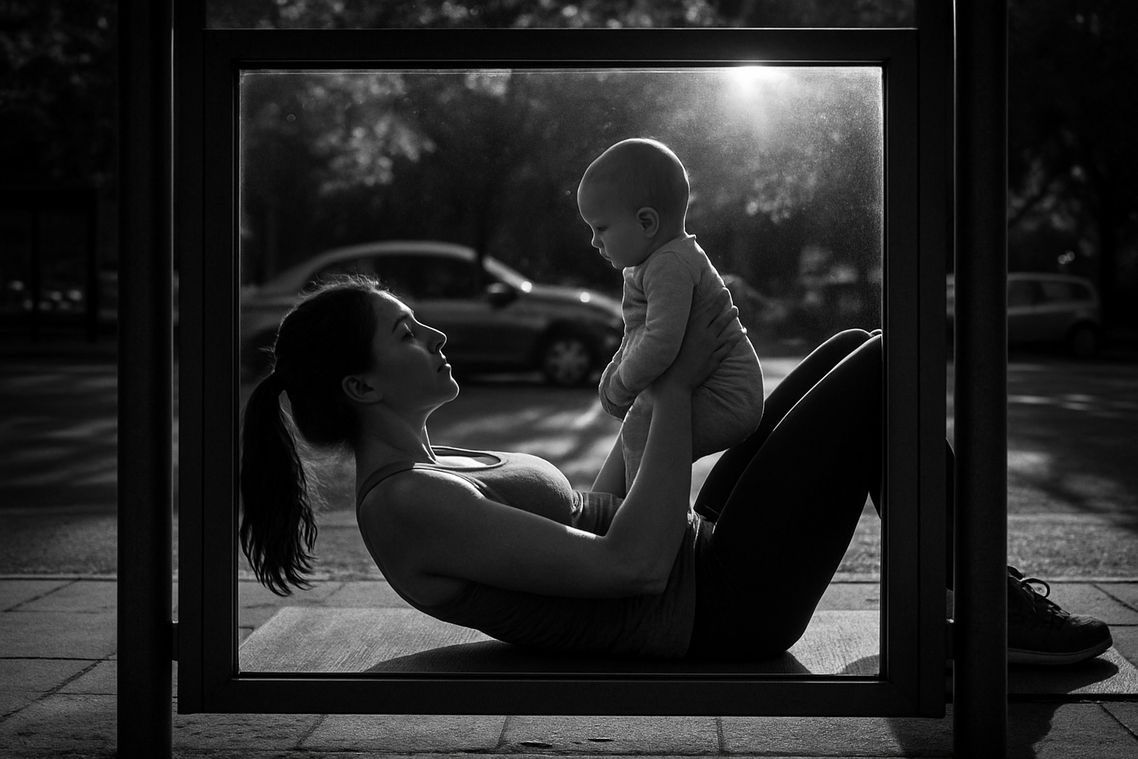
No childcare? No problem. Instead of choosing between a workout or your child, combine them. Think A vs. B: solo gym session (logistics, sitter, time crunch) versus integrated movement at home or the park (zero commute, built-in bonding). For many moms, option B wins on consistency alone.
Stroller Fitness vs. Treadmill Cardio
A treadmill keeps you stationary. A stroller walk adds fresh air and functionality. Try stroller walking lunges (step forward, lower back knee, keep core tight) or incline power walks. At the park, use a bench for push-ups or tricep dips. Pro tip: lock stroller wheels during stationary moves for safety.
Baby-Wearing Workout vs. Bodyweight Alone
Wearing your baby in a secure carrier turns simple squats and standing core twists into light resistance training. “Resistance” just means added weight that challenges muscles. Some argue this limits intensity—but for rebuilding strength postpartum, controlled, low-impact movement is often smarter (ACOG supports gradual return to exercise postpartum).
Playtime Fitness vs. Structured Circuits
Toddlers won’t wait through sets. So make it a game. Bear crawls, crab walks, and “toddler lifts” (hold securely, perform slow squats) blend laughter with leg day. Yes, it’s less precise than a circuit—but it builds sustainable fitness habits for moms.
And when exhaustion hits, revisit how to prevent burnout while raising young children: https://fpmomlife.net/how-to-prevent-burnout-while-raising-young-children/
Beyond Crunches: Rebuilding Your Core the Right Way
After baby, many moms want their core strength back—fast. So it’s tempting to default to crunches. However, crunches primarily target the rectus abdominis (the “six-pack” muscle). If you have diastasis recti—a separation of the abdominal muscles common postpartum—traditional crunches can increase intra‑abdominal pressure and worsen the gap (American College of Obstetricians and Gynecologists).
Instead, think A vs. B: Surface squeeze vs. deep stability. The real hero is the transverse abdominis (TVA)—the deep corset-like muscle that wraps around your torso and stabilizes your spine. When activated properly, it supports healing and function (think strength from the inside out).
So what works better?
- Heel Slides – Lying on your back, gently draw your belly inward, exhale, and slowly slide one heel away. Control is key.
- Dead Bug – Opposite arm and leg extend while you maintain core engagement. Slow and steady wins here.
- Modified Plank (on knees) – Focus on breathing out as you engage the TVA.
- Glute Bridges with Core Engagement – Lift hips while bracing gently, not bearing down.
Meanwhile, coordinate breath with every rep. Exhale on effort. Move deliberately.
Some argue crunches are “faster.” Maybe. But rebuilding smart beats rebuilding twice. Pair these moves with consistent fitness habits for moms, and progress becomes sustainable (and safer).
Your journey, your pace: embracing consistent effort means finding movement that fits into real, messy days. I truly believe the goal was never perfection, but manageable ways to weave strength into a packed schedule. The biggest pain point? Feeling like there’s no time or energy left for you. I’ve been there, and all-or-nothing plans only add pressure. Short, consistent workouts focused on functional strength are simply more sustainable. That’s how real fitness habits for moms stick. Pick one routine this week, show up, and celebrate that small win (yes, it counts). Consistency builds confidence, and confidence fuels momentum. Keep going.
You came here looking for realistic ways to stay consistent, energized, and confident in your daily routine—and now you have a clear, doable path forward. Balancing motherhood with your own well-being can feel overwhelming, especially when time, energy, and support are limited. That frustration is real. But it doesn’t have to stay that way.
By focusing on simple, sustainable fitness habits for moms, you’re not just squeezing in workouts—you’re building strength, patience, and resilience that carries into every part of your life. Small, intentional actions each day add up to lasting results.
Make Your Next Move Count
If you’re tired of putting yourself last and feeling drained by the end of the day, now is the time to change that. Start implementing these fitness habits for moms today and take back control of your energy, confidence, and routine. Thousands of moms are already transforming their daily lives with practical, proven strategies—don’t get left behind. Choose one habit, commit to it this week, and take that first step now.

 Gladys Mayersavers writes the kind of family buzz content that people actually send to each other. Not because it's flashy or controversial, but because it's the sort of thing where you read it and immediately think of three people who need to see it. Gladys has a talent for identifying the questions that a lot of people have but haven't quite figured out how to articulate yet — and then answering them properly.
They covers a lot of ground: Family Buzz, Curious Insights, Child Development Insights, and plenty of adjacent territory that doesn't always get treated with the same seriousness. The consistency across all of it is a certain kind of respect for the reader. Gladys doesn't assume people are stupid, and they doesn't assume they know everything either. They writes for someone who is genuinely trying to figure something out — because that's usually who's actually reading. That assumption shapes everything from how they structures an explanation to how much background they includes before getting to the point.
Beyond the practical stuff, there's something in Gladys's writing that reflects a real investment in the subject — not performed enthusiasm, but the kind of sustained interest that produces insight over time. They has been paying attention to family buzz long enough that they notices things a more casual observer would miss. That depth shows up in the work in ways that are hard to fake.
Gladys Mayersavers writes the kind of family buzz content that people actually send to each other. Not because it's flashy or controversial, but because it's the sort of thing where you read it and immediately think of three people who need to see it. Gladys has a talent for identifying the questions that a lot of people have but haven't quite figured out how to articulate yet — and then answering them properly.
They covers a lot of ground: Family Buzz, Curious Insights, Child Development Insights, and plenty of adjacent territory that doesn't always get treated with the same seriousness. The consistency across all of it is a certain kind of respect for the reader. Gladys doesn't assume people are stupid, and they doesn't assume they know everything either. They writes for someone who is genuinely trying to figure something out — because that's usually who's actually reading. That assumption shapes everything from how they structures an explanation to how much background they includes before getting to the point.
Beyond the practical stuff, there's something in Gladys's writing that reflects a real investment in the subject — not performed enthusiasm, but the kind of sustained interest that produces insight over time. They has been paying attention to family buzz long enough that they notices things a more casual observer would miss. That depth shows up in the work in ways that are hard to fake.