

If you’re searching for effective discipline strategies for kids, you’re likely looking for practical solutions that actually work in real-life parenting moments—not just theory. Whether you’re dealing with tantrums, backtalk, sibling rivalry, or daily routine battles, discipline can feel overwhelming and exhausting.
This article is designed to give you clear, actionable guidance on effective discipline strategies for kids that support healthy child development while maintaining a calm, connected home environment. You’ll learn how to set firm boundaries without yelling, encourage better behavior without constant punishment, and build mutual respect with your child.
Our guidance is grounded in child development research, evidence-based parenting approaches, and real-world application. We draw from established psychological principles and proven behavioral techniques to ensure the strategies shared here are both practical and developmentally appropriate.
By the end, you’ll have a confident, step-by-step approach to discipline that strengthens your relationship with your child while encouraging lasting positive behavior.
From Chaos to Calm: A Real-World Guide to Nurturing Good Behavior
Power struggles can make even the calmest parent feel like they’re negotiating a hostage situation (and somehow the toddler has the upper hand). You might hear that strict consequences or “because I said so” are enough. And yes, structure matters. However, research shows that authoritative parenting—firm but warm—leads to better long-term outcomes than harsh control (American Psychological Association).
So instead, try effective discipline strategies for kids rooted in connection: get on their eye level, name the feeling, then set the boundary. For example, “You’re mad. I won’t let you hit.” Clear, calm, consistent. Over time, cooperation replaces chaos.
The 3 Pillars of Positive Guidance: Routines, Connection, and Clear Expectations
Pillar 1: The Power of Predictability
Children thrive on ROUTINE. Predictability reduces anxiety because kids know what happens next (and surprises aren’t always the fun kind). Research from the American Academy of Pediatrics shows consistent routines improve emotional regulation and sleep quality. A simple visual schedule—wake up, brush teeth, breakfast, school, play, dinner, bath, bed—using pictures for pre-readers, turns expectations into something they can “see.” Some argue routines make life rigid. In reality, structure creates freedom; when kids feel secure, challenging behaviors often decrease.
Pillar 2: Connection Before Correction
Think of connection as filling a child’s “emotional cup” (a metaphor for their need for attention and belonging). Ten minutes of device-free play daily, letting them lead, boosts cooperation. Studies in child development link positive attention to improved listening skills. Skeptics say kids should just follow rules. But without connection, correction feels like criticism. PRO TIP: Schedule connection right before common meltdown times.
Pillar 3: Setting Loving Limits
Effective discipline strategies for kids balance firmness with empathy. Try: State the limit, Acknowledge the feeling, Offer a choice. “We don’t throw blocks. I see you’re frustrated. You can throw this soft ball or build a tower.” Clear, calm, consistent. Boundaries teach safety; kindness teaches trust.
Guiding Toddlers (Ages 1–3): Managing Big Feelings in Little Bodies)
Toddlers aren’t being “dramatic.” Their brains are under construction. The prefrontal cortex (the part responsible for logic and impulse control) is still developing, while the emotional center—the amygdala—is running the show. In simple terms: big feelings, tiny brakes.
Technique: Redirection
Redirection means guiding your child’s attention from something unsafe or inappropriate to something acceptable. A toddler’s brain is wired for distraction because curiosity drives learning. Instead of saying, “Stop touching that,” try, “Ooh, look at this interesting toy over here!” You’re not ignoring the behavior—you’re steering it. (Think of it like changing the channel before the meltdown season finale airs.)
Some argue this avoids teaching boundaries. But redirection is a boundary—just delivered in a brain-friendly way.
Technique: Name the Emotion
When you say, “You feel angry that playtime is over,” you’re practicing emotion labeling—putting words to feelings. Research shows labeling emotions reduces their intensity by helping the brain process them (Lieberman et al., 2007). Over time, toddlers build emotional vocabulary instead of defaulting to tantrums.
Naming feelings builds self-awareness.
Technique: Use Positive Language
Negative commands like “Don’t run!” focus on what not to do. Positive language—“Please use your walking feet inside”—tells the brain what action to take. Clear directions are easier to follow.
These are effective discipline strategies for kids because they teach skills, not fear. And as children grow, pairing them with routines like teaching kids responsibility through everyday tasks strengthens long-term habits.
Pro tip: Keep phrases short. Toddlers process fewer words than you think (usually under 10 at a time).
Guiding Preschoolers (Ages 3–5): Fostering Cooperation and Problem-Solving
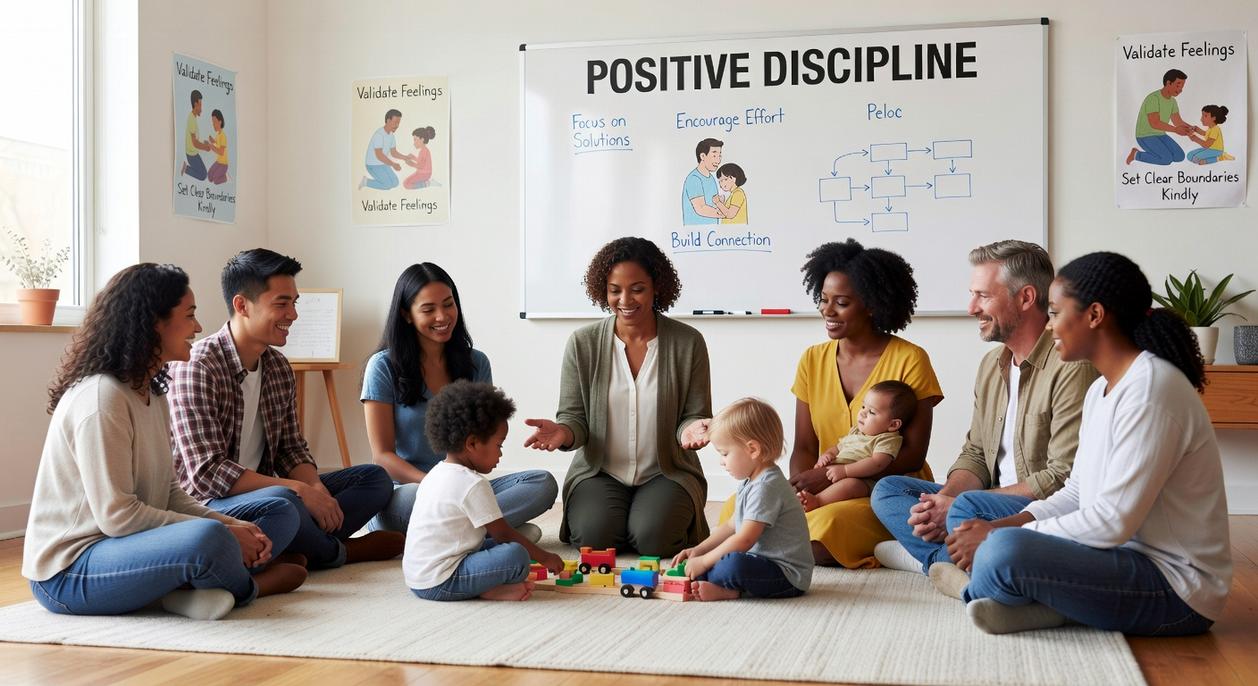
Preschoolers crave independence. After all, they’re in their “I do it!” era (very main-character energy). The trick is guiding that independence without turning every moment into a power struggle.
First, try offering limited choices. This means giving two acceptable options so your child feels in control while you stay in charge. For example: “Do you want to wear the red shirt or the blue shirt?” or “Time to clean up. Do you want to pick up the blocks or the cars first?” Psychologists call this structured autonomy—freedom within boundaries. Some critics argue choices invite negotiation. In reality, limiting options reduces overwhelm and builds decision-making skills.
Next, use when-then statements. This simple sequencing tool connects responsibility to reward: “When you put your shoes on, then we can go to the park.” It’s clear, calm, and predictable—no dramatic soundtrack required. (Think less Frozen meltdown, more steady narrator voice.) Research shows predictable routines improve cooperation in young children (American Academy of Pediatrics).
Finally, practice collaborative problem-solving. Instead of dictating solutions, ask: “We keep being late in the morning. What’s an idea you have that could help us get ready faster?” This builds executive function—the brain’s ability to plan and organize. Some adults think 4-year-olds are too young for this. Yet involving them fosters responsibility early.
Use effective discipline strategies for kids by blending structure with empathy—and watch cooperation grow.
Guiding School-Aged Kids (Ages 6+): Building Responsibility and Self-Discipline
As kids grow, they crave more independence—so this is your opportunity to guide, not control. Using effective discipline strategies for kids helps them connect actions with outcomes, building real-world responsibility that lasts far beyond childhood.
First, understand the difference between natural and logical consequences. Natural consequences happen on their own: if they skip a coat, they feel cold. Logical consequences are parent-created but connected: if laundry isn’t in the hamper, clean clothes won’t be available. The benefit? Kids learn accountability without lectures (and you avoid power struggles).
Next, try a simple weekly family meeting:
- Review schedules.
- Celebrate wins.
- Solve one challenge together.
Because children have a voice, they feel valued and more willing to cooperate.
Finally, focus on the “why” behind rules. When kids understand safety, respect, or health reasons, they develop internal motivation—not just obedience. Over time, that builds self-discipline you won’t have to enforce.
Your Path to a More Peaceful and Connected Family
You now have a toolkit of practical, positive methods to guide your child’s behavior at every key stage of development.
Remember, the goal isn’t perfect behavior but steady progress and a stronger parent-child connection.
Instead of punishment alone, use effective discipline strategies for kids that teach:
- Emotional regulation in hard moments
- Problem-solving during conflicts
- Accountability with empathy
This week, choose one technique, apply it consistently, and watch for small shifts.
Consistency beats perfection, and small wins compound over time.
Adjust as needed, stay calm, and keep showing up.
You’ve got this.
Create a Calmer, Happier Home Today
You came here looking for real solutions that actually work in everyday family life—and now you have them. From setting clear boundaries to staying consistent and calm, you’ve seen how small, intentional changes can transform the way your child responds and grows.
Parenting isn’t exhausting because you’re doing it wrong. It’s exhausting when you don’t have the right tools. Without structure and follow-through, behaviors escalate, routines fall apart, and everyone ends the day frustrated. That’s why using effective discipline strategies for kids isn’t about punishment—it’s about teaching, guiding, and building trust.
Now it’s your move. Start by choosing one strategy you learned today and apply it consistently this week. Stay patient. Track the progress. Adjust as needed.
Thousands of moms rely on these proven, real-world parenting techniques because they work in busy, imperfect homes. If you’re ready for fewer power struggles and more peaceful days, put these strategies into action now—and watch the difference unfold in your home.

 Calviner Brownder writes the kind of child development insights content that people actually send to each other. Not because it's flashy or controversial, but because it's the sort of thing where you read it and immediately think of three people who need to see it. Calviner has a talent for identifying the questions that a lot of people have but haven't quite figured out how to articulate yet — and then answering them properly.
They covers a lot of ground: Child Development Insights, Real-World Parenting Tips, Momlife Wellness Practices, and plenty of adjacent territory that doesn't always get treated with the same seriousness. The consistency across all of it is a certain kind of respect for the reader. Calviner doesn't assume people are stupid, and they doesn't assume they know everything either. They writes for someone who is genuinely trying to figure something out — because that's usually who's actually reading. That assumption shapes everything from how they structures an explanation to how much background they includes before getting to the point.
Beyond the practical stuff, there's something in Calviner's writing that reflects a real investment in the subject — not performed enthusiasm, but the kind of sustained interest that produces insight over time. They has been paying attention to child development insights long enough that they notices things a more casual observer would miss. That depth shows up in the work in ways that are hard to fake.
Calviner Brownder writes the kind of child development insights content that people actually send to each other. Not because it's flashy or controversial, but because it's the sort of thing where you read it and immediately think of three people who need to see it. Calviner has a talent for identifying the questions that a lot of people have but haven't quite figured out how to articulate yet — and then answering them properly.
They covers a lot of ground: Child Development Insights, Real-World Parenting Tips, Momlife Wellness Practices, and plenty of adjacent territory that doesn't always get treated with the same seriousness. The consistency across all of it is a certain kind of respect for the reader. Calviner doesn't assume people are stupid, and they doesn't assume they know everything either. They writes for someone who is genuinely trying to figure something out — because that's usually who's actually reading. That assumption shapes everything from how they structures an explanation to how much background they includes before getting to the point.
Beyond the practical stuff, there's something in Calviner's writing that reflects a real investment in the subject — not performed enthusiasm, but the kind of sustained interest that produces insight over time. They has been paying attention to child development insights long enough that they notices things a more casual observer would miss. That depth shows up in the work in ways that are hard to fake.