

If you’re searching for practical guidance on talking to kids about emotions, you’re likely looking for ways to help your child express feelings in a healthy, confident way. Maybe your child shuts down, has big outbursts, or simply doesn’t have the words to explain what they’re feeling. This article is designed to give you clear, real-world strategies you can use right away to make emotional conversations feel natural instead of forced.
We draw from established child development research and insights from parenting and wellness experts to ensure the advice you’re reading is both practical and grounded in evidence. You’ll learn how to create a safe space for open dialogue, model emotional awareness in everyday moments, and turn challenging situations into opportunities for connection and growth.
By the end, you’ll feel more equipped to guide your child through big feelings with calm, confidence, and compassion.
Start with an anecdote about a grocery store meltdown: my three-year-old sobbing because the bananas were “wrong.” In that moment, I realized he wasn’t dramatic; he was overwhelmed. Emotional fluency—the ability to name and understand feelings—turns chaos into connection.
For toddlers, keep it simple: “You’re mad. You wanted different bananas.” School-aged kids need nuance: “Are you frustrated or disappointed?” Pre-teens appreciate collaboration: “What do you think is behind that reaction?”
Talking to kids about emotions feels awkward at first (like narrating a nature documentary), but it works. Over time, meltdowns shrink—and conversations grow. That shift changes everything for families. Daily.
The Toddler & Preschool Years (Ages 2-4): Naming the Feelings
Between ages two and four, children are learning that big sensations in their bodies have names. This is where emotional vocabulary begins. Start simple: happy, sad, mad, and scared. Use them constantly and in context. “The girl in the book looks sad.” “You seem happy with your tower!”
Connect Words to Bodies
Toddlers feel emotions physically before they understand them mentally. Point it out gently: “You’re stomping your feet. You look very mad right now.” This builds the bridge between sensation and language. I’ll be honest—there’s debate about how early kids fully grasp emotional labels. Some experts argue comprehension lags behind repetition (Denham et al., 2003). Still, repetition consistently helps.
| Emotion | What It Might Look Like | What You Can Say |
|---|---|---|
| Happy | Smiling, clapping |
“You look happy!” |
| Sad | Tears, slumped shoulders | “It’s okay to feel sad.” |
| Mad | Stomping, yelling | “You seem mad right now.” |
| Scared | Hiding, freezing | “That felt scary.” |
Use mirrors, feeling flashcards, or favorite characters to practice. (Yes, even cartoon pups have big feelings.)
Most importantly, validate. Instead of “You’re fine,” try “It’s okay to feel sad we’re leaving.” talking to kids about emotions teaches them feelings are real, even when limits stay firm.
Early Elementary (Ages 5–7): Connecting Feelings to Causes
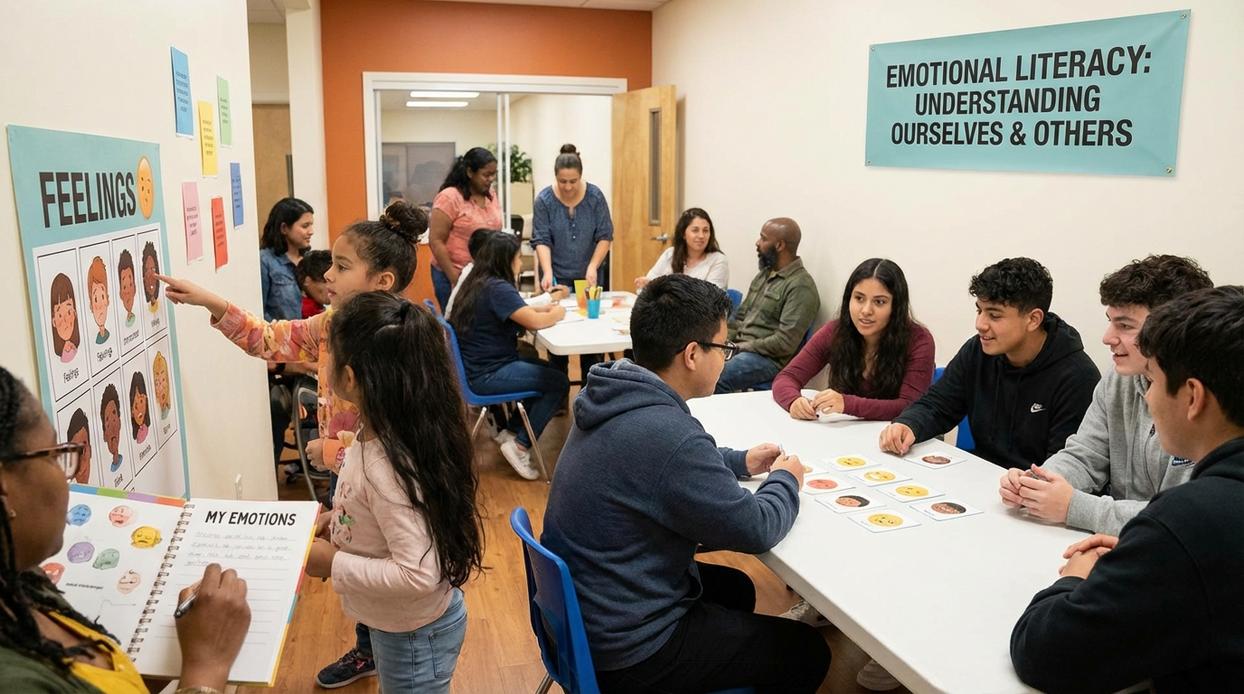
At ages 5 to 7, kids are ready to connect the dots between what they feel and why they feel it. This is where the magic word “because” comes in. When you say, “It sounds like you feel frustrated because the Lego tower keeps falling down,” you’re helping them build emotional cause-and-effect skills. In child development, this is called emotional literacy—the ability to recognize and name feelings and their triggers (Denham et al., 2003).
At the same time, it’s crucial to separate feelings from behavior. All feelings are valid; not all actions are. You might say, “I understand you’re angry at your brother, but we don’t hit. Let’s find another way to show him you’re upset.” This teaches emotional regulation, or managing reactions in healthy ways. If sibling tension is common in your home, explore strategies for managing sibling rivalry without taking sides.
Next, develop a simple calm-down plan. A cozy corner with a pillow, three dramatic “lion breaths,” or a favorite quiet song can work wonders. (Yes, even superheroes need a reset button.) Pro tip: Practice calm-down routines before big emotions hit so they’re easier to access in the moment.
Just as importantly, model your own emotions. “I’m feeling overwhelmed because there’s so much to do. I’m going to take deep breaths.” According to the American Academy of Pediatrics (2018), children learn regulation best through observation.
Looking ahead—this is speculation—but emotional skills may become as emphasized as reading and math in early classrooms. With rising awareness around mental health, talking to kids about emotions now could shape more resilient teens later.
Later Elementary (Ages 8–10): Navigating a More Complex World
By ages 8 to 10, children step into a more socially complex world. Friendships deepen. Recess politics get real (yes, it starts that early). This is the time to expand their emotional vocabulary beyond “mad,” “sad,” and “happy.” Introduce words like jealousy (wanting what someone else has), embarrassment (feeling exposed or self-conscious), anxiety (worry about what might happen), and disappointment (sadness when expectations aren’t met). Research from the Yale Center for Emotional Intelligence shows that children who can accurately label emotions demonstrate better self-regulation and academic performance.
It’s also important to explain that two feelings can exist at once. A child might feel excited about a class presentation and nervous about speaking. That’s normal. In fact, psychologists call this emotional complexity, and it increases during later childhood.
Shift from directing to problem-solving. Instead of, “Just ignore them,” try, “That sounds tough. What do you think you could do next time?” Studies published in Developmental Psychology suggest that children build stronger coping skills when adults guide reflection rather than dictate solutions. (Pro tip: silence after your question gives them space to think.)
Use stories to teach empathy. Ask, “How do you think that character felt?” or “How would you feel?” Story-based discussions improve perspective-taking skills, according to research from the University of Cambridge.
Most importantly, normalize hard feelings. Share age-appropriate moments when you felt embarrassed or anxious. Talking to kids about emotions openly reduces shame and strengthens trust—something every growing child needs.
Simple Hacks to Make Emotional Talks a Daily Habit
-
Rose & Thorn Dinner Ritual: During dinner, ask everyone to share one highlight and one hard moment. It sounds simple, yet consistency builds safety. I’m not entirely sure why, but naming feelings nightly lowers defenses.
-
Car Ride Confessions: Because there’s no eye contact, kids often relax. Meanwhile, you can practice talking to kids about emotions without pressure. (Silence can be golden.)
-
Bedtime Check-in: Before lights out, ask, “How is your heart feeling today?” Admittedly, some nights you’ll get shrugs, but other nights honesty appears. Over time, trust grows.
Raising emotionally aware kids, one conversation at a time isn’t about scripts; it’s about small, repeatable moments. You now have a roadmap for talking to kids about emotions from toddler tears to pre-teen eye-rolls. The overwhelm is real (yes, even on three hours of sleep), but consistency beats perfection. When you name feelings, you build resilience—defined as the ability to recover from stress (American Psychological Association). Some argue kids should “toughen up.” Research shows emotion coaching predicts stronger social skills (Gottman Institute). Safe space plus shared language equals lasting mental health. Start small: validate one feeling today right now consistently.
Helping Your Child Thrive
You came here wanting real, practical ways to support your child’s emotional growth—and now you have them. From creating safe spaces to modeling healthy expression, you’re better equipped to handle the meltdowns, the tough questions, and the big feelings that once felt overwhelming.
The truth is, ignoring emotions doesn’t make them disappear. It often makes parenting harder. When kids don’t feel understood, behaviors escalate and connection weakens. That’s why talking to kids about emotions isn’t just helpful—it’s essential.
Start small. Practice naming feelings during everyday moments. Stay consistent. Make emotional check-ins part of your routine. These simple steps can transform tension into trust and confusion into confidence.
If you’re tired of second-guessing your parenting or feeling stuck during emotional outbursts, don’t do it alone. Get practical, real-life parenting strategies that actually work. Join thousands of moms who rely on proven routines and expert-backed tips to raise emotionally strong, resilient kids. Start today and make calm, connected parenting your new normal.

 Norvain Vornhaven writes the kind of child development insights content that people actually send to each other. Not because it's flashy or controversial, but because it's the sort of thing where you read it and immediately think of three people who need to see it. Norvain has a talent for identifying the questions that a lot of people have but haven't quite figured out how to articulate yet — and then answering them properly.
They covers a lot of ground: Child Development Insights, Real-World Parenting Tips, Momlife Wellness Practices, and plenty of adjacent territory that doesn't always get treated with the same seriousness. The consistency across all of it is a certain kind of respect for the reader. Norvain doesn't assume people are stupid, and they doesn't assume they know everything either. They writes for someone who is genuinely trying to figure something out — because that's usually who's actually reading. That assumption shapes everything from how they structures an explanation to how much background they includes before getting to the point.
Beyond the practical stuff, there's something in Norvain's writing that reflects a real investment in the subject — not performed enthusiasm, but the kind of sustained interest that produces insight over time. They has been paying attention to child development insights long enough that they notices things a more casual observer would miss. That depth shows up in the work in ways that are hard to fake.
Norvain Vornhaven writes the kind of child development insights content that people actually send to each other. Not because it's flashy or controversial, but because it's the sort of thing where you read it and immediately think of three people who need to see it. Norvain has a talent for identifying the questions that a lot of people have but haven't quite figured out how to articulate yet — and then answering them properly.
They covers a lot of ground: Child Development Insights, Real-World Parenting Tips, Momlife Wellness Practices, and plenty of adjacent territory that doesn't always get treated with the same seriousness. The consistency across all of it is a certain kind of respect for the reader. Norvain doesn't assume people are stupid, and they doesn't assume they know everything either. They writes for someone who is genuinely trying to figure something out — because that's usually who's actually reading. That assumption shapes everything from how they structures an explanation to how much background they includes before getting to the point.
Beyond the practical stuff, there's something in Norvain's writing that reflects a real investment in the subject — not performed enthusiasm, but the kind of sustained interest that produces insight over time. They has been paying attention to child development insights long enough that they notices things a more casual observer would miss. That depth shows up in the work in ways that are hard to fake.